In Bulgarian folklore, a funeral is a supreme life event, comparable in significance to one’s birth.
Every individual has the full right to form their own beliefs and choose whether or not to rely on Bulgarian folklore. Drawing upon our roots, we at the Charon family choose a positive perspective, found within the customs of Bulgarian folklore that relate directly to death and our perception of it. It is precisely our perception of death that allows us to build an understanding of the funeral process—one that we do not impose on those who choose us, but rather offer as a new perspective.
The prevalence of black attire, tears, lamentations, and states of distress or depression is often based on a lack of information and faith regarding the concepts of ‘death’ and ‘burial.’ We do not blame you for this, and we would be pleased to present the various church rituals, celebrations, and customs associated with funerals.
No, the word ‘celebrations’ is not a mistake here. it is used because, since ancient times, Bulgarians have viewed the onset of death as a sacred and supreme celebration for the soul of the deceased, and by extension, for their loved ones. Bulgarian folklore lacks egoism and egocentric dramatization over the loss of a person; instead, it emphasizes the elevation of the soul as it finds its freedom and peace. Although the funeral agency is responsible for organizing and executing all mourning rituals in coordination with the bereaved, it is helpful for you to understand what these rituals actually entail and what choices are available to you.
Bulgarians have their own faith, which defines many of the understandings regarding the onset of death and the funeral itself. Mourning rituals are not always connected to the church, though they often rely upon it.
Death
According to belief, St. Archangel Michael takes the person’s soul, leading to their passing. If the dying person smiles, tradition holds that the Archangel is handing them a golden apple; if they shudder, it is believed they see the saint’s sword or are drinking from the bitter cup he offers. The onset of death is announced by a characteristic tolling of the church bell—the death knell—and the rhythm of this tolling indicates whether the deceased is a man or a woman.
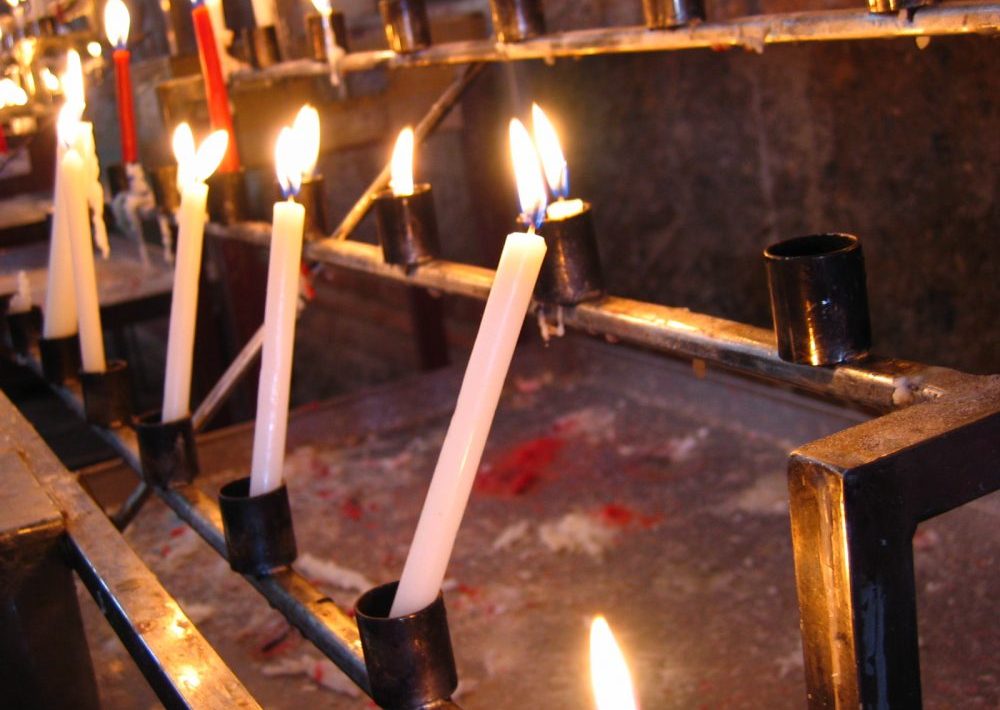
One custom involves covering mirrors and all other reflective surfaces immediately after death, so the deceased does not see their reflection and decide to return. Water is poured out, and all doors and windows are closed to allow the soul to depart more easily. Clocks are stopped. The body is never left alone for a moment, as it is believed that if a cat or dog jumps over it, the deceased will become a restless spirit. For the same reason, the body must not remain in the dark; the mourning ritual requires at least a faint light to be present by the body at all times.
Part of the celebratory rituals includes the kneading of a ritual bread (pitka). We call them celebratory because, as mentioned earlier, the transition of the soul from one world to another is a momentous occasion. Upon death, a ritual bread is kneaded, creating a parallel with the other most important moment in human life—birth—when a ritual bread is also prepared.
Following the custom of kneading the bread, the soul of the deceased leaves the home once this warm loaf is broken. This closes the cycle of human life that began at birth.
Once the ritual bread is kneaded, the ritual dictates the washing of the deceased. Water is brought specifically for this purpose in a black cauldron, which is not taken back into the house afterward but is turned over with a stone placed on top; it remains this way until three days after the funeral.
The body is laid in an east-west direction until the time for the funeral arrives.
Regarding the grave, it is important to know that it is dug on the day of the funeral. It must not remain empty overnight, to prevent another death in the family. While working, the gravediggers are careful not to jump over or pass anything across the grave, lest the deceased become a restless spirit. If old bones are found in the grave, they are washed with wine and placed in a cloth within the grave alongside the deceased.
Funeral
The funeral begins with the removal of the deceased from the home—while inside, they are treated as if alive, but once taken out, the separation from the household and the living begins. This moment is always the most emotional, as it is when the departure and the loss are truly realized. The body is carried out feet first. Custom dictates that when carrying the body or transporting it by car, stops should be made at several crossroads.
If you wish for the custom to be fully observed and a priest is present, it is important to know that he leads the procession. He is followed by the person carrying the wheat, then the one with the wooden cross, then the deceased, and finally the relatives, arranged by their degree of kinship. Anyone who encounters the procession is obliged to stop, remove their hat, and wait for it to pass. It is forbidden to cross the path of a funeral procession, not just in its immediate path but within its line of sight. Crossing water and the pouring of wine are linked to the belief that the world of the dead is separated from the living by a river that the deceased must cross. Therefore, a coin is placed with them to pay the ferryman who will take them to the other side.
Bread and wheat are distributed by the grave, and any remaining food must not be brought back home. While the funeral is taking place, women—housekeepers—should remain in the house to tend to the home. Dust and the broom are removed from the dwelling; they are thrown into water, burned, or placed at a crossroads.
These are only some of the church beliefs, customs, and mourning rituals. We cannot dictate which ones you should observe, but please do not hesitate to consult with us regarding the various options.